
Elephants
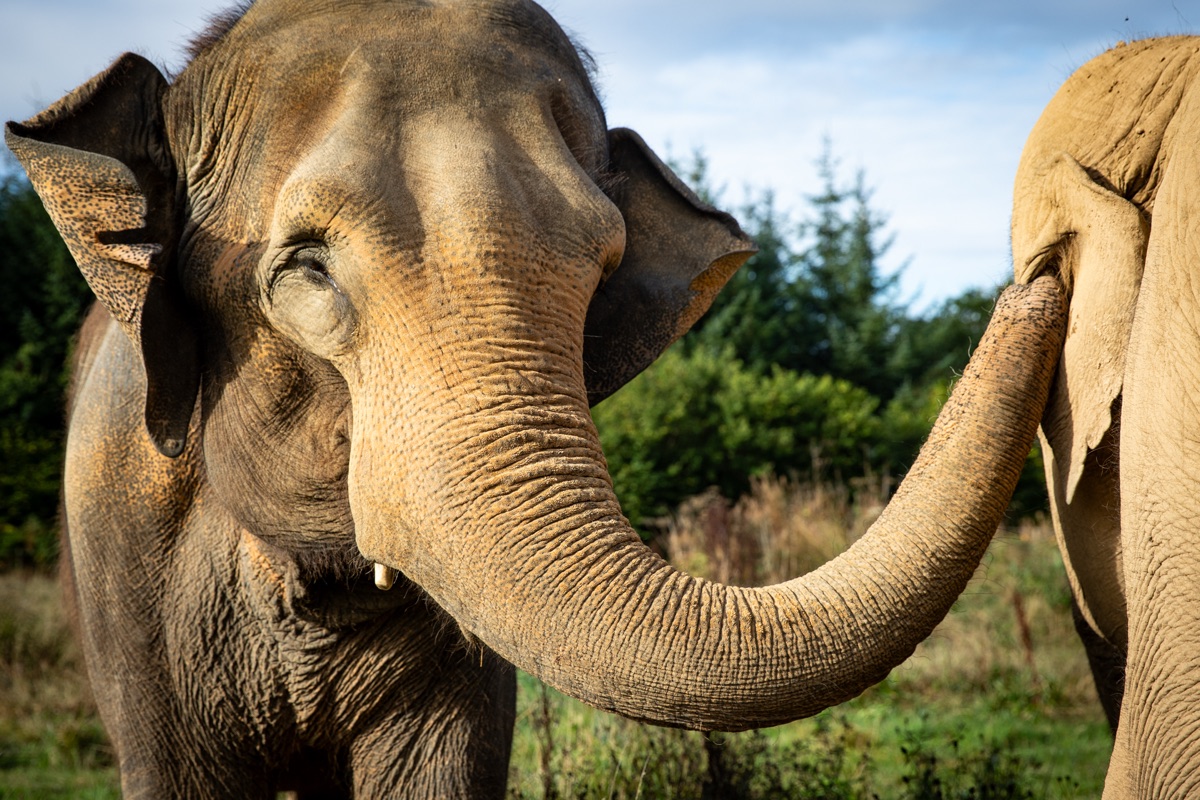
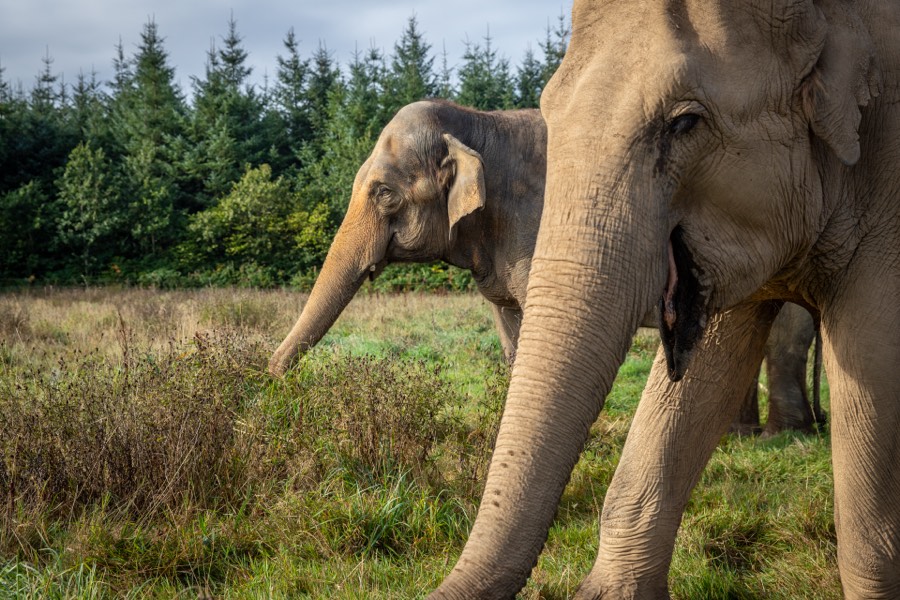
Two Asian elephants live at Skanda Vale. Valli came here as an orphaned calf in 1981 and has been here ever since. Bala joined her in August 2026, from Liberec Zoo in the Czech Republic, and the two of them have been more or less inseparable since the first morning.
They share a purpose-built barn at the top of the ashram, seven acres of grazing they can get out to at any hour, and a hundred acres of woodland to walk in. You might see them out in the fields as you walk around the ashram, though nothing about their day is arranged around visitors, so it rather depends on where they’ve decided to be.
Daily life
Most of what the elephants eat, they choose for themselves. Their walk takes them out across a hundred acres of woodland, where they browse on gorse, nettle, bramble, hazel, hawthorn, beech, larch bark, heather and bilberry, as well as a multitude of different wild grasses, and they’ll go a long way for a good stand of gorse in midsummer. One of them once got through around 25kg of nettles in a single hour.
The rest is brought to them: hay grown on the land here, five or six willow trees each a day, and grass pellets carrying their vitamins. There’s very little fruit, to keep the sugar down. In summer the hay all but disappears from the diet and they spend up to eighteen hours a day foraging, which is close to how a wild elephant fills her time.
The forest walk is the best part of the day, and what makes it valuable is choice — streams to wade through, banks to rub against, mud to wallow in, fallen trees to negotiate, and the scent of deer and foxes to follow up on, as well as a seemingly endless wild food supply.
Between walks the fields are theirs to come and go from as they please, through sliding doors they open themselves, and on summer nights they often stay out until morning. CCTV covers the barn and every field, so we can look in on them at any hour without disturbing them.
Valli likes to be scrubbed by hand. Bala much prefers the pressure washer, and leans into the spray to steer it towards whichever bit she wants done next. Either way it amounts to a thorough exfoliation, which elephant skin needs to stay healthy.
In warmer weather the keepers finish with a fresh mudpack, though the elephants are perfectly capable of digging their own wallows, and do. Mud works as a moisturiser and as a barrier against biting insects.
Valli
Valli was born in the Batticaloa district of Sri Lanka in 1980 and orphaned as a calf. She was found sheltering with a herd of water buffalo, who had taken her in and were looking after her, and was brought to the Pinnawala Elephant Orphanage.
In 1981 the President of Sri Lanka gave her to Guru Sri Subramanium, in recognition of Skanda Vale’s service to the Sri Lankan community in Britain. She arrived that November, about eighteen months old and still on milk.
She was the first temple elephant at Skanda Vale. Elephants are understood to purify a place, and to stand as living representatives of Ganesha. Her care fell to Swami Karunananda, then known as Brother Peter, who looked after her from the day she arrived until his death forty-three years later.


“I thought Guru was crazy. What do you want to bring an elephant here for? Three weeks before Valli was due to arrive, Guru just said: ‘Brother Peter, you’re looking after the elephant.’ I didn’t sleep for two years. I had to boil five gallons of water every four hours. I slept in the straw by Valli, but I’d be lucky if I had any straw left in the morning, because she used to pinch it through the night. She’d come over and put her head in my lap to sleep. Your legs would be killing you from this big baby head, but there was immense joy in those times.”
Valli is 46 now.
Valli Takes a bath
A poem by Mab Jones
I step through a hatch of shadow and we’re
nose to trunk, my white eye drawn up to that one
which is liquid as amber, brown as a coconut,
tufted lashes thick as the brush the monk uses
to soap the creature clean. Valli
is two years younger than I am, but
her wrinkles are rivulets to let the water run,
to hold the mud her dermis needs to breathe.
She was born as my hands, my face, will become:
lined and creased, parchment pressed into shape
around the cosmic dust of bones. I watch as she dips
the soft lips of her trunk into the metal bowl
and blasts her body with suds. Brother
bathes her twice a week, he says, sloughing
the flesh from her hulk so it can replenish,
the fresh skin a regeneration which, in this
land, requires man’s hand in the place of palms.
My own show paths fanning into futures I won’t know as
the frayed map edge of her ears gently furl,
the mala beads of her forehead shine. Her strength and her
tenderness are as everyday and as unstoppable
as time; as humble and as powerful as a birth.
She is a firebreath of life wrapped in a dinosaur form,
natal yet ancient, primordial but still in the hands
of the priest as, during our end, that great cleansing, we all are.
Bala
Bala arrived on the evening of 31 August 2026, at the end of a 1,700km journey she had been preparing for over several months, and she settled in almost at once.
She is 42, and she came to Skanda Vale for company. She spent her early years with a circus in Berlin before moving on to zoos in Hamburg and then Münster, and in 2013 she went to Liberec, where she found a real friend in an older female called Rání. The two of them were a contented, settled pair for eight years, and it was the patient daily work of her keepers there that brought Bala into the good health she enjoys now.
After Rání died in 2021, Liberec spent two years looking for somewhere she could have both space and another elephant beside her, working with the European coordinator responsible for the welfare and social needs of Asian elephants. What brought her to Wales in the end was Valli, keepers who live alongside the elephants, and care available at any hour of the day or night.
Three of her Liberec keepers travelled with her and stayed on for several days, walking her round the fields, showing her the barn and passing on everything they know about her. They had looked after her for thirteen years, and it was not an easy goodbye.
Bala and Valli took to one another straight away. There was a great deal of rumbling and squealing when Bala came off the lorry, and after a quiet night’s rest the two of them met properly in the morning and greeted each other like old siblings. They have barely been apart since, grazing and wallowing and playing together, and the bond between them is already a strong one. Bala has come here for life.

Laksmi and Camela
Laksmi and Camela were born in Asia around 1966 and spent most of their lives in circuses, latterly with Cirque Medrano in France, where they were known as Lechmee and Kamala. They were together for the best part of fifty years.
Laksmi came to Skanda Vale in October 2018, blind from cataracts and with a stiff foreleg. It took time and a good deal of coaxing to build her up to the daily forest walk, but she got there in the end, and once she had she took to it completely: she dug her own mud wallows deep in the woods and used them all year round, snow included.
On walks she held on to Valli’s tail to guide her until she reached the forest, and then she would confidently follow the scent of tracks and foliage to the best eating places.
Camela followed afterwards. Because the two of them already knew each other, an introduction that normally takes weeks of careful stages was complete within hours — they simply walked back into each other’s company as though the intervening years hadn’t happened, and all three elephants spent that first day together.
They died at the ages of 58 and 59, much loved by everyone who looked after them. Very old elephants need a great deal of hands-on attention, and that suits the way we live here: keepers in rooms adjoining the barn, someone nearby day and night, and vets who know them as individuals.
The elephant barn
The barn was built in 2013 for Valli, with the thought that other elephants might one day join her. Inside there are two sand areas and a rubber-floored washing area. The sand is a metre deep and drains quickly, which makes it good for digging, building mounds and hunting out buried apples.
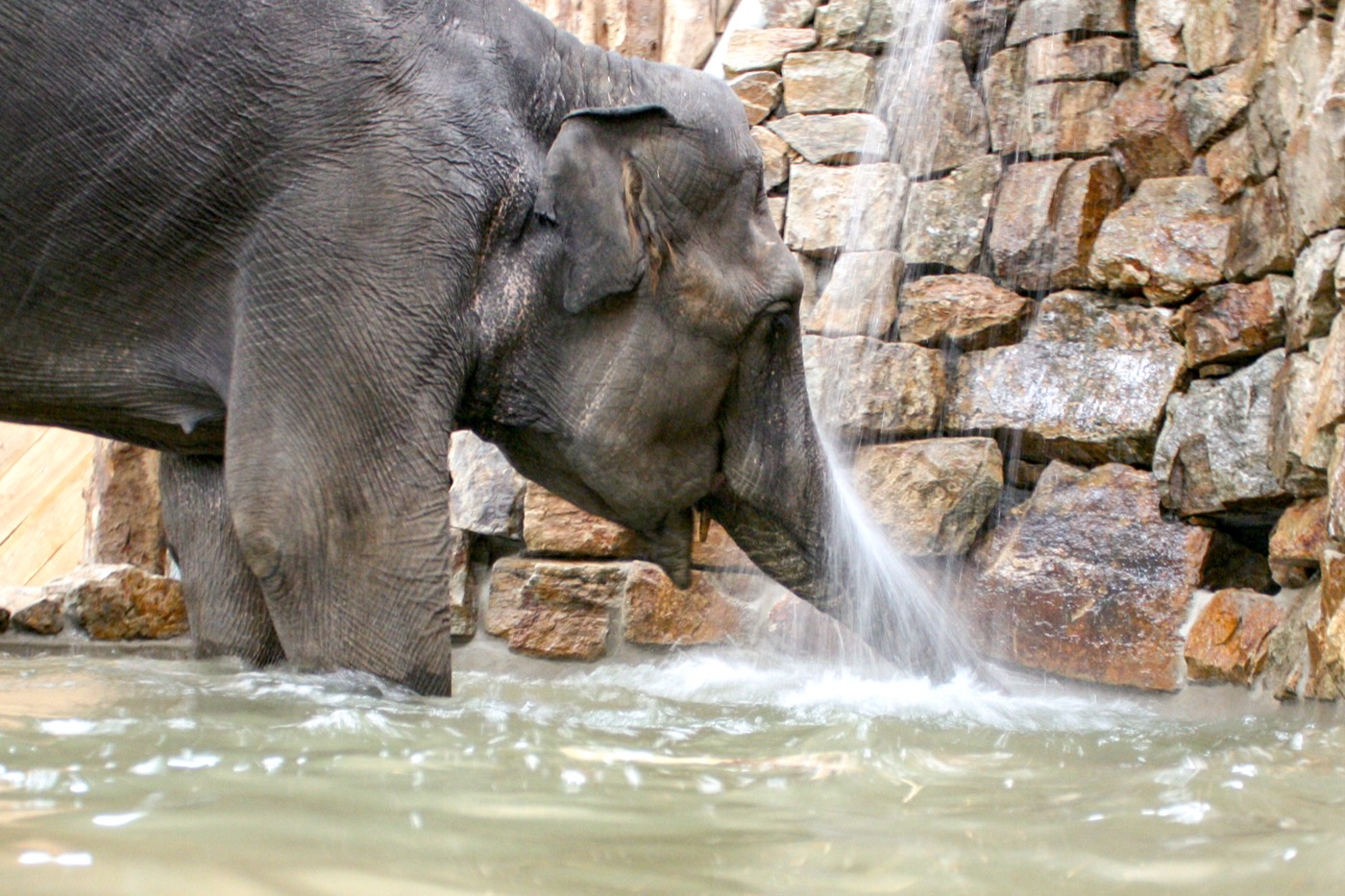
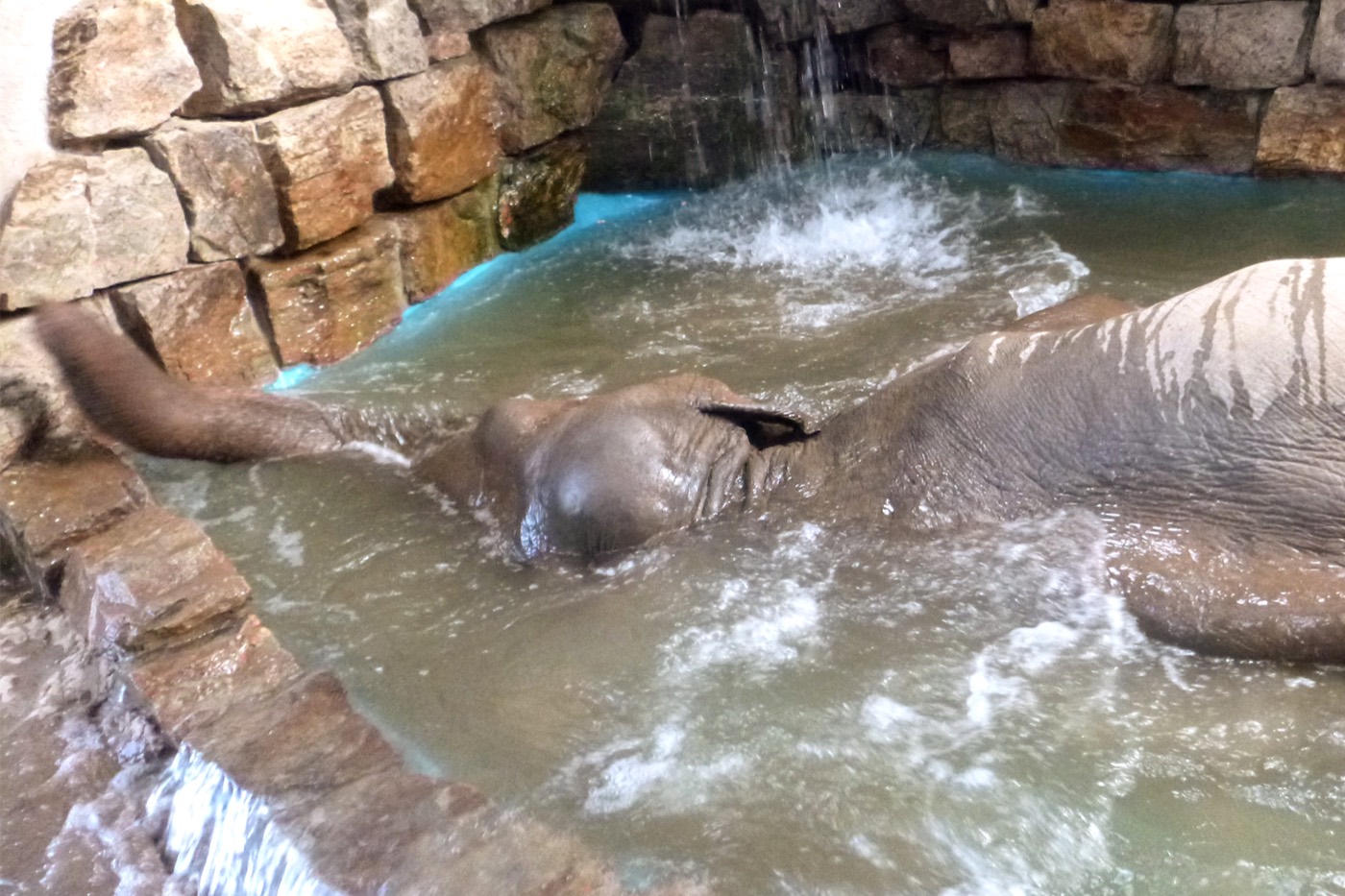
The walls are clad with logs to rub and scratch against, and the render outside is deliberately rough for the same reason. A heated wall runs through the building and can reach 40°C, so the elephants can pick whichever temperature suits them, and they lean against it to rest. There is a pond with a waterfall in one corner, and the heating comes from a boiler burning wood cut on the estate.
Outside there’s a slate yard that drains fast and is ideal for dust bathing, the grazing fields beyond it, and mounds of topsoil left out for mud baths. The elephants are never shut out of the building.


Valli has had the same tyre since she was young and still carries it about the barn with her. She has also spent several years taking part in enrichment research here, which produced a set of devices that let an elephant trigger sounds for herself. One of them became a firm favourite, and she was often filmed using it in the small hours, between naps.
Common questions
We’re afraid not. The elephants aren’t on display, and there’s no viewing area or visit to the barn. You may catch sight of them out in the fields as you walk around the ashram, but that depends on where they happen to be, so please don’t make the journey expecting to see her.
No. Photography isn’t permitted anywhere at Skanda Vale, and that includes the elephants. Like everything else here, they aren’t a tourist attraction.
The elephants are licensed by Carmarthenshire County Council, and the licence is only renewed, every two years, after the council’s animal health officers and an independent vet have inspected the elephants, the barn, the land and our records. A local practice sees them every few weeks, and two specialist elephant vets advise us, alongside a standing group of elephant experts.
Elephants have a large body volume relative to their surface area, so a warm elephant takes several hours to start losing heat, even outdoors in winter. The barn is heated, they’re never locked out of it, and the heated wall lets them pick the temperature they want. In genuinely bad weather the walk is shortened.
We keep an eye out for elephants who need a home, and at the moment we’re focused on offering retirement to older elephants with high care needs. Our animals aren’t kept for display — looking after them is part of the community’s monastic life — and any elephant coming here would come because this was the best available place for that particular animal.